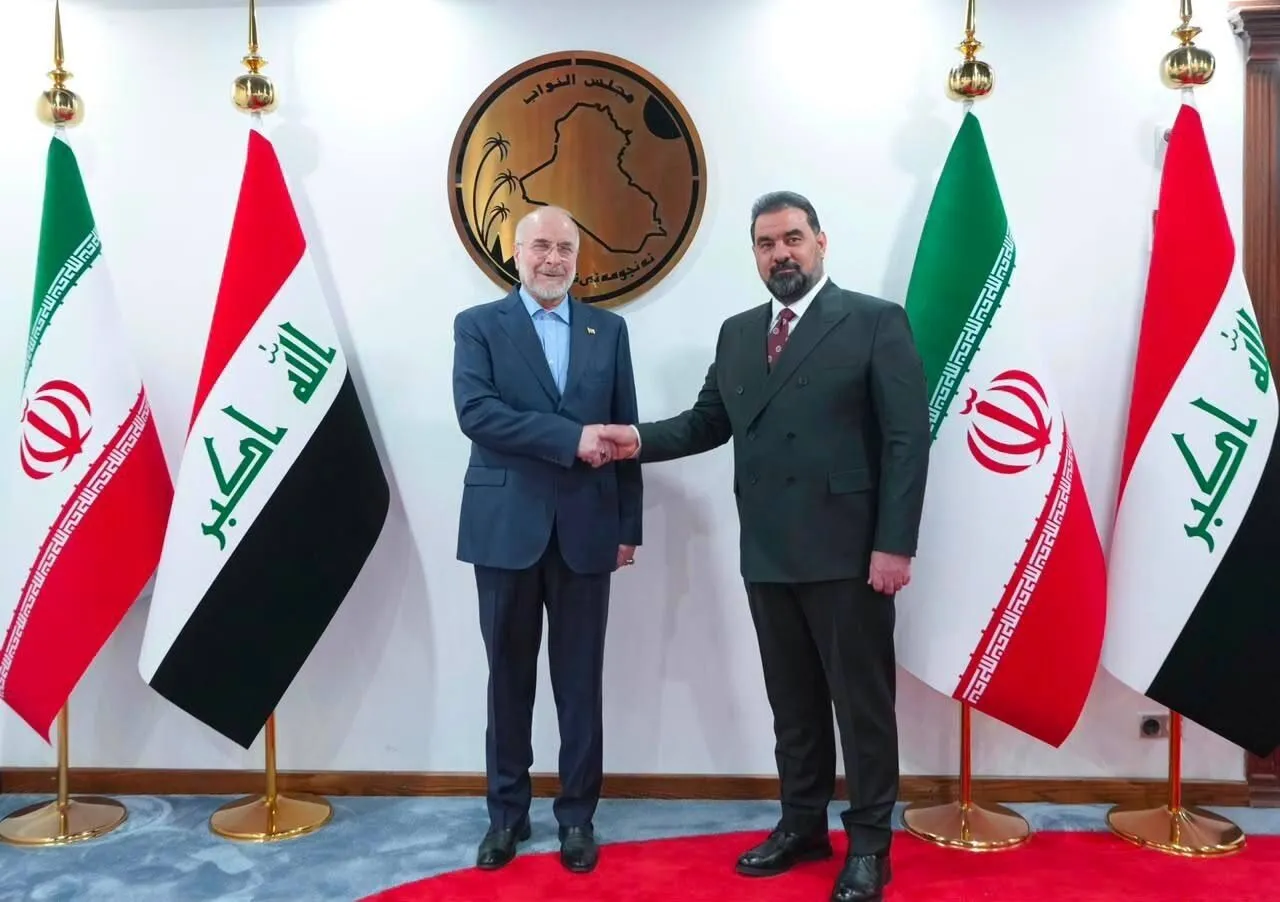
Iranian Parliament Speaker Mohammad Bagher Ghalibaf calls for expanding economic cooperation between Iran and Iraq, saying bilateral economic relations should match the strength of the two countries’ political and cultural ties during talks with his Iraqi counterpart on the first day of his official visit to Iraq.
Ghalibaf met Iraqi Parliament Speaker Haibat al‑Halbousi and a group of Iraqi lawmakers, alongside an Iranian parliamentary delegation, on Wednesday to discuss bilateral relations, regional developments, and parliamentary cooperation.
Opening the meeting, Ghalibaf congratulated al‑Halbousi on the formation of Iraq’s parliament and his election as speaker.
He thanked the Iraqi government and people for the mass funeral procession held for the martyred Leader of the Islamic Revolution, Ayatollah Seyyed Ali Khamenei. He expressed appreciation for Iraq’s hospitality toward Arbaeen pilgrims.
“The government, the people, the tribes, and the entire Iraqi nation spared no effort in hosting the pilgrims of Imam Hussein and in the funeral procession for our martyred Imam, which brought us comfort and encouragement.”
Turning to regional affairs, Ghalibaf slammed the United States and the UK for instigating instability across the Middle East.
“The criminal United States and its interventions are responsible for all the region’s crises. The cancerous tumor of Israel, planted in our region by Britain, has brought about these losses.”
He said Iran had challenged US influence through the resilience of its people, the capabilities of its armed forces, and the leadership of the country’s commander‑in‑chief.
“Today, the United States is trapped in desperation. Whether it withdraws from war or continues it, it faces loss of credibility and mounting problems.”
Ghalibaf said Iran’s experience had demonstrated the strategic value of resistance.
“Resistance is the only path to victory, and if we are not prepared for war, negotiations will also bear no fruit.”
On bilateral cooperation, Ghalibaf emphasized the importance of strengthening parliamentary engagement through friendship groups and regular exchanges between lawmakers.
He identified the Shalamcheh–Basra railway, the dredging of the Arvand Rud, and deeper economic integration as key priorities that both parliaments could help advance in coordination with their governments.
“The weakness in our bilateral relations is most evident in economic cooperation, which is not as strong as our political and cultural relations.”
In response, Haibat al‑Halbousi welcomed the Iranian delegation and described the mass funeral procession for Iran’s martyred Leader as “a turning point in the emotional, spiritual, and political bond between the two countries.”
Referring to the recent US‑Israeli‑imposed war, he praised the Iranian people’s historic and legendary resistance against the Israeli regime’s aggression.
“The people of Iraq, the Iraqi government, and all political figures oppose the aggression of the Zionist regime against Iran. Iraq also believes Israel is a cancerous tumor and must be eliminated.”
Concluding the meeting, al‑Halbousi said the withdrawal of US forces from Iraq was imminent and stressed the need to further expand bilateral relations, particularly in the economic sector.
He also called for facilitating Iraq’s oil exports through the Strait of Hormuz.


