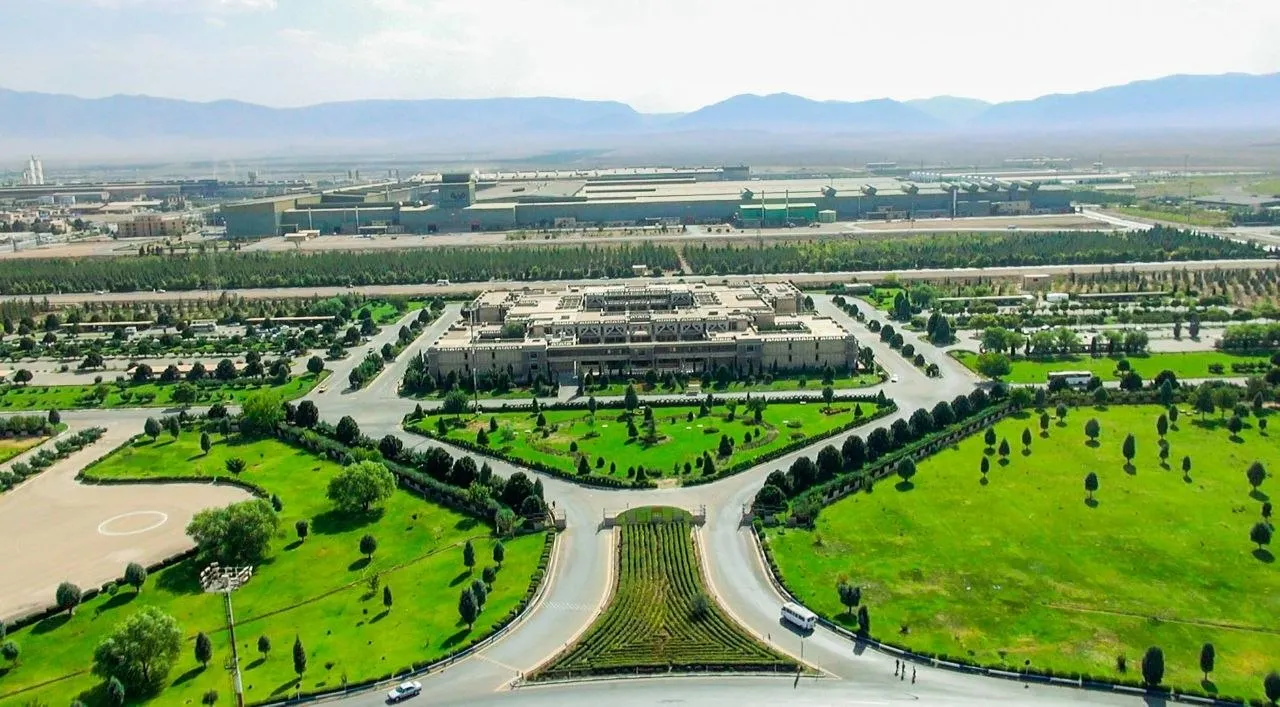
The 21st century rested on the heavy shoulders of concrete and the grand narrative of mass production at any cost—an era in which the wheels of industry turned with smoke and fire, and steel was merely a symbol of harsh, brutal power. Today, however, on the threshold of a new era, those grand narratives of linear, endless progress have reached a dead end. The world no longer seeks tonnage alone; rather, it seeks meaning at the heart of production. In this paradigm shift, Mobarakeh Steel has risen not merely as an industrial unit, but as the author of a powerful Petit Récit (minor narrative) in the geography of the Middle East—a narrative in which iron merges with green wisdom to portray an eco-compatible future.
Moving Beyond the Grand Narrative of Smoke Contemporary thinkers believe that the era of legitimacy for grand narratives has come to an end, and now is the time for local and specialized language games. In the steel industry, the 20th-century grand narrative that claimed "industry equals inevitable pollution" has now lost its validity. By changing the rules of this game, Mobarakeh Steel has transformed production from a purely industrial activity into an eco-compatible, forward-looking process. This is a linguistic rupture in the traditional logic of the market, where value is no longer summarized solely in net profit, but redefined in carbon intensity and ecological sustainability. Understanding this global transformation, this massive industrial complex has converted its identity from a harsh giant into a responsible entity devoted to creating a better future.
The Global Scale: Beyond the Clouds On the global steel map, numbers are not merely digits; they are words that narrate competitive power. According to official 2025 statistics, Mobarakeh Steel, with a production of 10.29 million tons, has not only consolidated its position at 43rd among the world's top steelmakers, but in a historic leap has also surpassed the veteran German giant, Thyssenkrupp (with a production of 9.41 million tons).
Yet this superiority is not solely in quantity. The new language game is built upon the carbon footprint. Iran holds the world's first rank with a production of 37.2 million tons of Direct Reduced Iron (DRI). This technological infrastructure is the winning card of Mobarakeh Steel’s brand in the era of green steel. While the traditional Blast Furnace / Basic Oxygen Furnace (BF-BOF) method—which accounts for a large portion of global production—emits 2.66 tons of CO2 per ton of steel, the production pathway in this massive industrial complex (DRI-EAF), with an intensity equivalent to 1.66 tons, presents a much cleaner and more humane narrative of industry. This statistical gap is precisely the point where Mobarakeh Steel’s green wisdom weighs heavier on the global scale than traditional European competitors.
Green Wisdom: The Noble Architecture of Sustainability Mobarakeh Steel has chosen sustainability not as a formal attachment, but as the very fabric of its strategy. By implementing international standards such as ISO 14064 and ISO 14067, the company has employed transparency as a tool of legitimation in the postmodern world. A look at the company's development map shows a multiplicity of novel projects: Reducing water consumption to 2.5 cubic meters per ton of production demonstrates the nobility of this industry when facing the region's limited water resources. Furthermore, in clean energy, it has made manifest to all the transition from the grand narrative of fossil fuels toward a multiplicity of renewable energy sources through this symphony of light and wind, constructing the Aftab-e Sharq Solar Power Plant with a capacity of 600 MW and the Sangan Wind Power Plant. The 914 MW Combined Cycle Power Plant has established investment in high-efficiency technologies (Class F) to supply sustainable energy and reduce energy waste.
The Circular Pulse in the Body of Green Business In postmodern logic, knowledge and data are the strategic commodities of the new age. By investing 1.8 trillion Tomans in industrial refining projects and the continuous monitoring of pollutants, Mobarakeh Steel has put data at the service of the environment. The concept of the circular economy in this company has transformed from a slogan into a concrete process; from recycling lime fines to processing oily sludges and oxide powder, everything returns to the production cycle. Steel is no longer a heavy, perishable material; rather, it is a structure with high recyclability that is reborn time and again within the body of modern civilization.


